mashroo3k Consulting Company offers a feasibility study for a meat products factory project in Yemen, with the highest return on investment and the best payback period. This study is based on a series of in-depth studies of the Yemen market size, an analysis of competitors’ strategies, and the provision of competitive pricing.
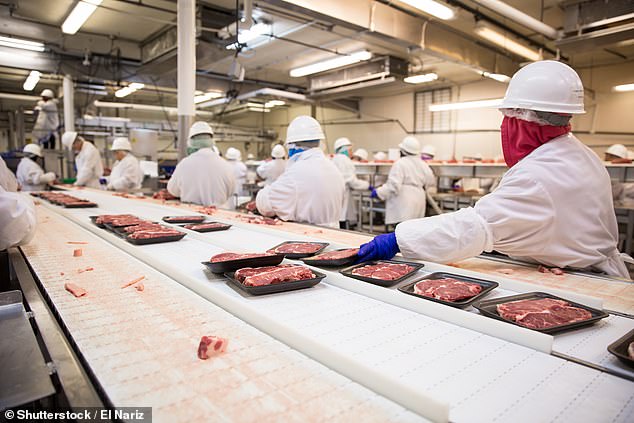
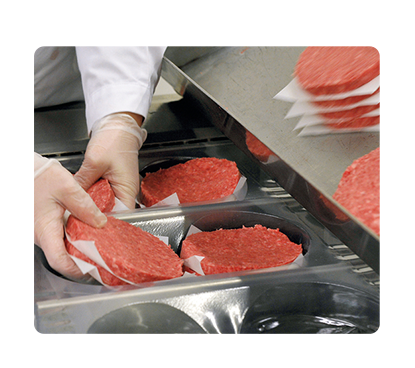
The meat products factory prepares and processes meat into various products, such as sausages and hamburgers. The factory targets hotels, restaurants, wholesalers, and retailers. Those interested in developing meat products in Yemen, or developing existing projects, will conduct a series of specialized feasibility studies based on updated databases specific to the Yemen market. This will help ensure the project’s success, achieve the highest return on investment, and provide the best payback period.
Executive summary
Study project services/products
Market Size Analysis.
Risk Assessment.
Technical Study
Financial Study
Regulatory and Administrative Study

The Gulf Cooperation Council (GCC) countries comprise 0.7% of the world’s population; however, they represent 3% of global spending on processed food and beverages, at $102 billion out of a total of $3.4 trillion. This indicates that per capita food consumption in the region exceeds the global average. This is not surprising if we examine the situation closely. The population of the GCC countries now exceeds 58 million, and an estimated 56.3% of this population falls within the 25-54 age group. This important segment is the most dynamic and youthful segment of the food industry, compared to other groups.
Because Saudi Arabia accounts for approximately 59.7% of the total population of all GCC countries, and its share of the food and beverage market exceeds 53%, Mashroo3k Company decided to present indicators of this vital market in this blessed land. According to our latest available statistics:
By the end of the second quarter of 2021, the number of food product factories was estimated at 916, with 249 under construction. The number of beverage factories was 209, while the number of factories under construction was 71.
The number of food product factories represents 11.1% of the total number of existing and productive factories (8,258), and beverage factories represent 2.5% of the total number of factories in the Kingdom.
The food and beverage market in Saudi Arabia was estimated at approximately SAR 168.8 billion.
By the end of 2021, food consumption reached SAR 221 billion, a growth rate of 6%.
According to international reports, the value of food consumption in Saudi Arabia is US$70 billion, equivalent to 60% of the total food consumption in the Gulf region.
The fast food market in Saudi Arabia is expected to reach US$4.5 billion in the next three years. The size of the organic, health, and specialty food market in the Kingdom reached $27 billion, and the size of the halal food products market reached $6 billion.
Saudi Arabia’s food and beverage imports are estimated at approximately $14.5 billion annually.
In 2020, operating expenses for food and beverage services were estimated at approximately SAR 34,032.10 million, compared to SAR 30,069.23 million in 2018.
Food and beverage services operating revenues were estimated at SAR 61,557.77 million in 2020, compared to SAR 54,866.87 million in 2018.
Food and beverage services operating expenses are expected to reach SAR 52,489.34 million in 2027. Operating revenues for the same activities are expected to reach SAR 92,084.64 million (2027).
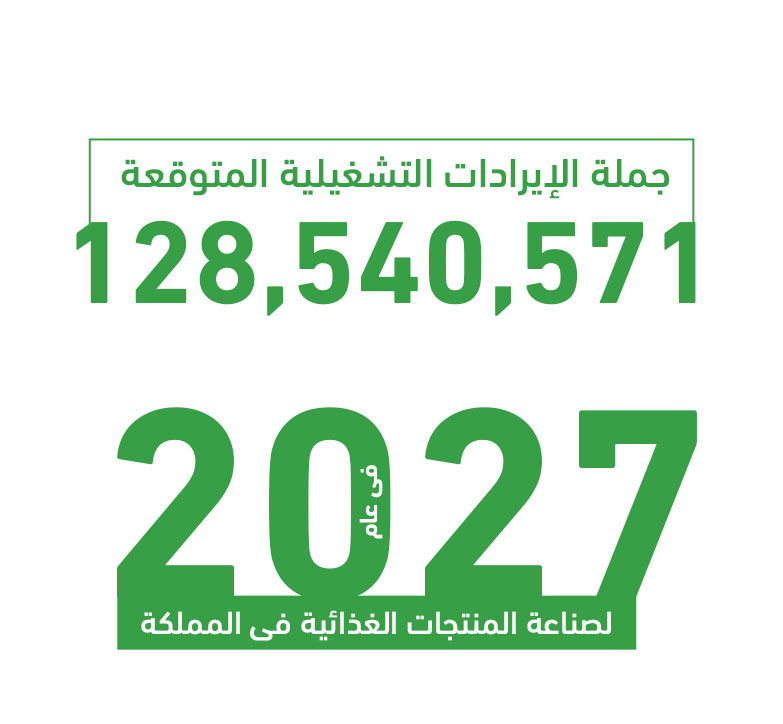
SAR 128,540,573 is the total expected operating revenue for the food industry in Saudi Arabia in 2027.
Global Food Sector:
According to UNICEF, the global malnutrition index rose to 9.8% in 2021.
Between 702 and 828 million people suffer from hunger worldwide.
Food market revenues are approximately US$8.66 trillion.
7.8% of the total food market revenues will be generated online.
9.4 billion tons is the total global primary crop production.
337 million tons is the total global red and white meat production.
883 million tons is the total global fruit production.
1128 million tons is the total global vegetable production.
201 million tons is the total world production of vegetable oils.
883 million tons is the total world production of dairy products.
83 million tons is the total world production of eggs.
The fast-food market in Saudi Arabia is expected to reach $4.5 billion in the next three years.
The organic, healthy, and specialized food market in the Kingdom is valued at $27 billion, while the halal food market is estimated at $6 billion.
Saudi Arabia imports approximately $14.5 billion worth of food and beverages annually.
In 2020, operating expenses for food and beverage services were estimated at SAR 34,032.10 million, compared to SAR 30,069.23 million in 2018.
Regarding operational revenues in the food and beverage sector, they were valued at SAR 61,557.77 million in 2020, up from SAR 54,866.87 million in 2018.
By 2027, operating expenses for food and beverage services are expected to reach SAR 52,489.34 million, while operational revenues are projected to reach SAR 92,084.64 million.
The total projected operating revenues for the food production industry in Saudi Arabia by 2027 are estimated at SAR 128,540,573 thousand.