The College of Engineering project is an investment concept aimed at establishing a specialized academic institution offering integrated educational programs in various engineering disciplines. This project relies on the design of modern buildings that include advanced laboratories and classrooms equipped with the latest technology, providing a distinguished educational environment that meets the needs of students. Additionally, curricula will be developed that are compatible with international standards, with a focus on enhancing the technical and practical skills required by the labor market. Furthermore, the College of Engineering project seeks to establish strong partnerships with local and international engineering companies and institutions to provide practical training opportunities that enrich the student experience and enhance their ability to apply theoretical knowledge in real-world situations. Furthermore, specialized research programs and workshops will be offered, aimed at developing students’ innovation and entrepreneurship skills. Furthermore, the project seeks to attract distinguished professors and experts in all engineering-related fields to ensure the quality of education and supervise research. Accordingly, the College of Engineering project seeks to prepare a generation of innovative engineers capable of meeting future challenges and developing society.

The College of Engineering project represents an ambitious vision to create an integrated educational institution that prepares qualified engineers to meet the challenges of the future. The college relies on the latest educational technologies, such as virtual reality and self-learning, to provide an advanced and flexible learning experience. It also focuses on enhancing practical aspects through strategic partnerships with the industrial sector, providing students with training opportunities in real-world work environments and equipping them with the skills required by the job market. In addition, the college develops specialized programs in modern engineering fields, such as artificial intelligence and the Internet of Things, in addition to offering advanced graduate programs for those wishing to delve deeper into various engineering disciplines. To encourage innovation, the college is working to establish business incubators that support students in transforming their creative ideas into successful entrepreneurial projects. Thanks to this integrated approach, the College of Engineering project represents a qualitative shift in university education, blending theoretical knowledge with practical application, enabling graduates to integrate effectively into the modern job market.
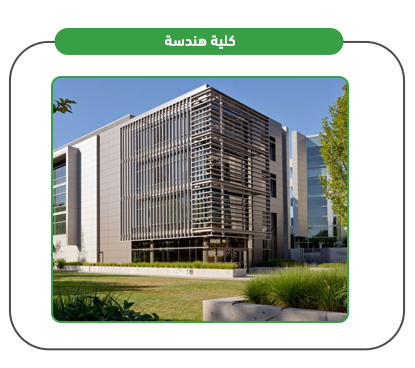
Advanced academic programs in various engineering fields<br>Advanced laboratories equipped with the latest technology<br>Academic consulting and guidance for students<br>Practical training programs in cooperation with companies<br>Support for scientific and engineering research<br>Employment and vocational training services<br>Comprehensive digital library<br>Organizing student activities and engineering competitions


Offering diverse engineering specializations that meet global market demands.
Buildings and laboratories equipped with the latest technology.
Partnerships with industrial institutions to provide field training opportunities.
Curricula that keep pace with the latest scientific and technological developments.
Encouraging scientific research and innovation in various engineering fields.
Enhancing students’ critical thinking and problem-solving skills.
Providing services that help students integrate into the job market after graduation.
Participating in regional and international scientific competitions and exhibitions to promote innovation.
Executive summary
Study project services/products
Market Size Analysis
Risk Assessment
Technical study
Financial study
Organizational and administrative study

Believing in the importance of the education sector and its role in localizing the national workforce, “Mashroo3k” Consulting presents key indicators of the education sector in the GCC, encouraging investment in this vital field:
The total number of students in the early childhood development stage (nurseries and kindergartens) in the GCC reached 851.5 thousand, according to the latest statistics.
The number of students in school education stages in the GCC is approximately 9.3 million (79.4% in public schools and 20.6% in private schools).
Adult education centers have around 181,247 students enrolled.
Higher education institutions accommodate 2,206,446 students.
The number of early childhood education teachers is 50,647.
The number of school education teachers is 727,904.
There are 5,806 early childhood education institutions in operation.
The number of school education institutions is 32,310.
Over the past years, GCC governments have worked to bridge the gap between education and the job market by adopting curricula that focus on vocational and technical education and promoting modern learning technologies.
The GCC countries have also increased education spending and enhanced quality to ensure that graduates meet the private sector’s labor demands.
According to the latest statistics, the percentage of national budgets allocated to education in the GCC countries is as follows:
Saudi Arabia: 18.9%
United Arab Emirates: 14.8%
Oman: 12.2%
Bahrain: 9.8%
Kuwait: 12.3%
Qatar: 10.5%
By 2023, the private education market in the GCC is expected to reach $26.2 billion.
The global education services market was valued at $2,882.52 billion by the end of 2021.
Experts estimate that the market will reach $3,191.79 billion by the end of 2022, achieving a compound annual growth rate (CAGR) of 10.7%.
By 2026, the market is projected to grow to $4,623.90 billion, with a CAGR of 9.7% during the forecast period.
By 2030, the global value of education as an industry will reach US$10 trillion.
By 2024, the value of online education worldwide will reach US$247.46 billion.
The AI education market will expand at a compound annual growth rate of 36% from 2022 to 2030.
In 2000, the number of students worldwide was approximately 657 million, and this number increased to 739 million in 2019.
In 2000, the number of secondary school students was approximately 452 million, and this number increased to 601 million in 2019.